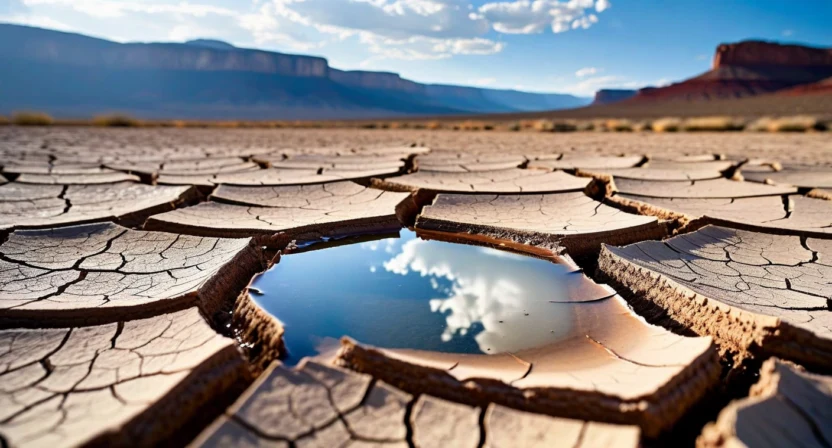
The Colorado River Compact was signed in 1922. It allocated water based on flow measurements taken during the wettest 20-year stretch in the river's recorded history. Everyone downstream has been living off that accounting fiction ever since. The reckoning is no longer theoretical.
Lake Mead hit its lowest recorded water level in June 2022 — 1,040 feet above sea level, compared to its maximum of 1,229 feet. The 2023 and 2024 winter snowpacks helped, but not enough to change the structural trajectory. Arizona, Nevada, and California have agreed to reduce withdrawals as part of a crisis negotiation that is still unresolved at the state line. Agricultural users are already receiving Tier 1 and Tier 2 cuts in Arizona. Tier 3 cuts would eliminate most irrigation water for agriculture in the state's lower basin.
We think this is a $40B problem that's generating about $2B in annual investment. That gap is an opportunity.
The Scale of the Problem
The Colorado Basin supplies water to roughly 40 million people and 5 million acres of irrigated farmland. California's Central Valley, the nation's most productive agricultural region, depends on a combination of Colorado River water, Sierra Nevada snowmelt, and groundwater. All three of those sources are under pressure simultaneously.
The economic value at risk is hard to overstate. California alone produces over $50B in agricultural output annually. Arizona's irrigated agriculture generates roughly $4B. The infrastructure — canals, aqueducts, irrigation systems, groundwater wells — represents hundreds of billions in existing capital investment that becomes worthless without reliable water supply.
The adaptation requirement is significant. Farms that want to survive in the Southwest over the next 20 years need to reduce water consumption by 20–40% relative to current use, switch to less water-intensive crops, or find supplemental water sources that don't depend on river allocations.
Where the Investment Opportunity Is Real
Subsurface sensing and predictive modeling. Most agricultural groundwater use in the Southwest is poorly measured. Growers know roughly how much they're pumping, but they don't know the real-time depth of their aquifer, how their neighbors' pumping is affecting their availability, or how much extraction they can sustain without inducing irreversible compaction. Companies building real-time monitoring and predictive depletion models for arid farmland are addressing a genuine data gap with regulatory and operational urgency behind it.
Drip and subsurface irrigation conversion. Many Southwest farms still use flood or furrow irrigation. Converting to drip saves 30–50% of water per acre on average, but the capital cost and agronomic knowledge barrier is real. Companies that solve the financing, installation, and management support side of that transition — not just the hardware — are addressing a much larger market than hardware-only players.
Water recycling for agricultural use. Treated municipal wastewater is an underused agricultural water source. Several Arizona municipalities are moving toward direct agricultural reuse agreements, where farms adjacent to treatment facilities receive consistent, contract-priced water that doesn't depend on river allocations. The infrastructure to match supply and demand — metering, treatment quality monitoring, contract management — is nascent and undercapitalized.
The Regulatory Accelerant
This is the piece of the Southwest water story that we think investors are underestimating. For most of the last century, agricultural water users in the Southwest faced no regulatory pressure to reduce consumption. That has changed materially in the last five years.
California's SGMA implementation is forcing Critically Overdrafted basins to submit sustainability plans with teeth — actual pumping restrictions enforced with fines. Arizona's new active groundwater management policies in the Phoenix and Tucson AMAs create similar mandates. These aren't suggestions. They're compliance requirements with legal enforcement behind them.
Compliance demand is the most durable customer motivation we know. A grower who has to demonstrate reduced extraction or lose their water right is a far more motivated buyer than a grower who might save money on water bills by being more efficient.
Why This Is Midwest VC Territory
We're a Chicago-based fund and we focus most of our deal activity on the Midwest and Great Plains. Why are we writing about the Southwest?
Two reasons. First, many of the companies solving Southwest water problems are founded in the Midwest — university spinouts from Colorado, Iowa State, and Purdue are doing foundational work in subsurface sensing and predictive hydrology. Second, the Great Plains has the same problem on a slower timeline. The Ogallala aquifer decline in western Kansas and eastern Colorado is measured in decades, not years — but the endpoint is the same. Companies building for Southwest drought tech are building technology that will be needed in the Midwest too, with a 15-20 year lag.
We've made one investment directly in Southwest water technology, and we're actively looking at two more. If you're building in this space — monitoring, efficiency, recycling, or prediction — we want to talk.